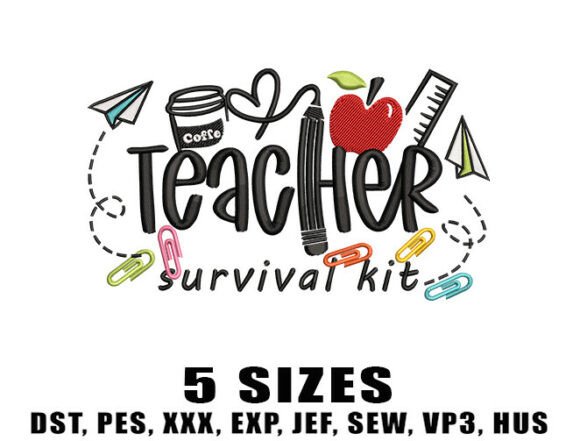
Teacher Survival Kit: Embroidery Design Review
As an embroidery designer specializing in commercial merchandise and branded assets, I approach every new machine embroidery design with a critical eye toward production viability. When evaluating the "Teacher Survival Kit" for potential use in small business merchandise, my primary focus shifts from mere decoration to functional branding. While the product description highlights its suitability for t-shirts, towels, and home decor with a vibrant and imaginative flair, business owners and apparel decorators must assess how this design translates into professional brand identity markers like patches, uniforms, and retail goods.
Visual Personality and First Impressions for Business
The title "Teacher Survival Kit" immediately evokes a sense of community, resilience, and appreciation. From a design perspective, this suggests a visual language that is likely playful yet structured, balancing whimsy with legibility. For a small business owner or Etsy seller, this aesthetic is gold. It moves beyond generic clip art and taps into an emotional niche. However, when reviewing this embroidery file for commercial application, I look for clarity over complexity. A design intended for a "survival kit" theme often includes multiple elements—icons, text, and borders. My first impression hinges on whether these elements are distinct enough to read at a glance on a busy sales floor or in a dimly lit café.
If the design leans too heavily into intricate detail, it may lose its impact as a chest logo or cap accent. Conversely, if it captures that "vibrant and imaginative flair" mentioned in the description through bold shapes and smart color blocking, it becomes a versatile asset for custom apparel. The key for merch creators is determining if the design’s personality aligns with their specific brand voice. Is your boutique rustic and muted, or bright and modern? This design seems to favor the latter, making it ideal for businesses that want to project energy and approachability.
Real-World Applications: Patches, Uniforms, and Merch
In my experience outfitting creative studios, bakeries, and local shops, versatility is the metric of success. The Teacher Survival Kit has significant potential as an embroidered patch. Patches are the ultimate low-risk, high-reward branding tool because they can be applied to denim jackets, tote bags, and caps without committing to permanent stitching on expensive inventory. If this design digitizes well with a clean merrowed edge or satin border, it serves as an excellent add-on product for teacher appreciation events or staff recognition programs.
For apron embroidery in cafés or florist shops, this design could serve as a morale-boosting badge rather than a primary corporate logo. Imagine a barista wearing a standard branded apron with this design stitched on the pocket or sleeve as a seasonal or thematic accent. It adds character without compromising the primary business branding. Similarly, as a tote bag design, it transforms a utility item into a desirable retail product. Teachers and parents frequently purchase reusable bags; offering a stylish, relevant design increases the perceived value of the handmade product and encourages repeat customers.
Staff uniforms also benefit from such designs, provided they are used intentionally. Instead of replacing the main company logo, this design works best as a secondary mark for special campaigns, open houses, or community outreach days. It humanizes the staff and creates a talking point with customers, fostering engagement and trust.
Production Constraints and Technical Considerations
Despite its charm, not every digital embroidery file performs equally across all substrates. As a professional reviewer, I must highlight where caution is necessary. The phrase "imaginative flair" sometimes implies variable stitch lengths or decorative fills that can be problematic on textured fabrics. If you plan to use this for cap embroidery, verify that the design has been specifically digitized for curved surfaces. Standard flat designs often distort on caps due to the cylinder shape of the hoop. Always request a cap-specific version or test extensively before bulk production.
Stitch density is another critical factor. If the Teacher Survival Kit features heavy fill areas combined with fine lettering, it may cause puckering on lightweight t-shirts or performance wear. For small business merch meant to be washed frequently, such as work shirts or aprons, dense designs can lead to fabric fatigue. I recommend testing the design on a scrap piece of your actual garment material using the appropriate stabilizer. Cut-away stabilizers are generally safer for knits and stretchy fabrics, while tear-away may suffice for stable canvas totes.
Be wary of tiny lettering. In "survival kit" themes, there is often a list of items or small text. If the letters are smaller than 4mm in height, they may not stitch out clearly, leading to thread breaks and illegible branding. Before purchasing or producing, zoom in on the design preview to check spacing and minimum text size. If the details are too fine, consider using the design only at larger sizes or opting for a simplified version for commercial embroidery projects.
Strengthening Brand Identity and Customer Trust
Embroidery signals permanence and quality. When a customer sees a well-executed design on a product, it subconsciously reinforces trust in the business. Using the Teacher Survival Kit effectively requires treating it as a cohesive part of your design assets library. Visual consistency builds recognition. If your shop uses pastel tones, ensure the thread colors selected for this design match your existing palette. A jarring color mismatch can make even a beautiful design feel out of place.
Furthermore, this design can elevate product value. A plain towel is a commodity; a towel featuring a clever, professionally stitched Teacher Survival Kit is a gift. For Etsy sellers and crafters, this differentiation is vital. It allows you to charge a premium for the customization and artistic effort. However, this only holds true if the execution is flawless. Poor registration, loose threads, or distorted outlines will damage your reputation faster than a great design can build it. Professionalism in the finished product reflects directly on your brand's integrity.
Essential Designer Notes for Commercial Success
Before running this design on any merchandise for sale or staff use, adhere to these professional protocols:
- Test in Black and White: Run a grayscale test stitch-out first. This reveals the underlying structure and density without the distraction of color. If the design lacks definition in monochrome, it may need editing.
- Verify Hoop Size Compatibility: Confirm the design dimensions fit your machine’s hoops with adequate clearance. Crowding the hoop leads to tension issues and misalignment.
- Create a Printable Mockup: Before physical production, overlay the design onto photos of your actual products. This helps visualize scale and placement, ensuring the design doesn't overwhelm the item.
- Check Licensing Terms: The product description mentions embellishing fabrics but does not explicitly state commercial licensing terms. Always verify if you have the right to sell finished products featuring this design. Protecting your business legally is as important as the aesthetic quality.
- Fabric Texture Matching: Test on the exact fabric you intend to use. A design that looks crisp on cotton twill might sink into minky or fleece. Adjust underlay or topping as needed.
- Compare Beside Other Assets: Print the design at actual size and place it next to your current logos. Ensure the visual weight and style are compatible.
By approaching the Teacher Survival Kit with technical diligence and strategic intent, small business owners can transform a delightful digital file into a powerful tool for connection and commerce. Whether used for staff appreciation, retail merchandise, or community branding, success lies in respecting both the art of embroidery and the realities of production.